What to Expect During Your First Spinal Decompression Visit at Abundant Life
If you are dealing with persistent back pain, sciatica, stiffness, or discomfort that affects your daily activities, you may have heard about spinal decompression as a non-surgical treatment option. If you are considering it for the first time, you may also have questions about what happens during the appointment.
Knowing what to expect can make your first visit feel more comfortable. At Abundant Life Chiropractic, spinal decompression is approached as part of personalized care based on your symptoms, health history, and individual goals.
Spinal decompression generally refers to non-surgical approaches designed to reduce pressure on structures around the spine. Cleveland Clinic explains that nonsurgical spinal decompression may involve traction or other techniques intended to reduce pressure on spinal structures.
It is important to understand that spinal decompression is not appropriate for every person or every type of back pain. A thorough evaluation helps determine whether it may be a reasonable option for your situation.
What Is Spinal Decompression?
Spinal decompression is a non-surgical approach that may use controlled stretching or traction to influence the spine.
The spine contains vertebrae, discs, joints, muscles, ligaments, and nerves. Problems involving these structures can sometimes contribute to back pain, leg pain, numbness, tingling, and restricted movement.
Cleveland Clinic notes that nonsurgical spinal decompression may be considered for certain conditions involving discs, nerves, and other spinal structures.
However, having back pain does not automatically mean decompression is the appropriate treatment. Your symptoms, health history, and physical condition should be considered before beginning care.
Why Your First Visit Matters
Your first appointment is more than simply getting onto a treatment table. It is an opportunity for your provider to understand what you are experiencing and determine what type of care may be appropriate.
Your evaluation may include questions about:
-
Where your pain is located
-
When your symptoms started
-
Whether your pain travels into your arms or legs
-
Whether you experience numbness or tingling
-
What activities make your symptoms better or worse
-
Previous injuries
-
Previous treatments
-
Your general health history
-
Your goals for care
Try to describe your symptoms as accurately as possible. You do not need to use medical terminology. Simply explaining when your symptoms occur, what they feel like, and what makes them better or worse can provide valuable information.
Mayo Clinic explains that back pain can have many different causes, making appropriate evaluation important when determining treatment.
Discuss Your Health History
Your health history can provide important information about whether spinal decompression is appropriate for you.
Be prepared to discuss previous:
-
Back injuries
-
Car accidents
-
Falls
-
Spinal surgery
-
Disc problems
-
Imaging
-
Treatments
-
Medications
-
Significant health conditions
You should also mention any recent changes in your health or symptoms.
Being open about your medical history allows your provider to make more informed decisions about your care and determine whether additional evaluation may be necessary.
A Physical Assessment May Follow
Depending on your symptoms, your first appointment may include a physical assessment.
Your provider may evaluate your movement and observe how you:
-
Stand
-
Walk
-
Bend
-
Rotate
-
Move your spine
-
Respond to certain movements
The purpose is to gather more information about your physical condition and determine whether your symptoms may be appropriate for conservative care.
In some cases, additional diagnostic testing, imaging, or referral to another healthcare professional may be recommended before treatment begins.
What Happens During Spinal Decompression?
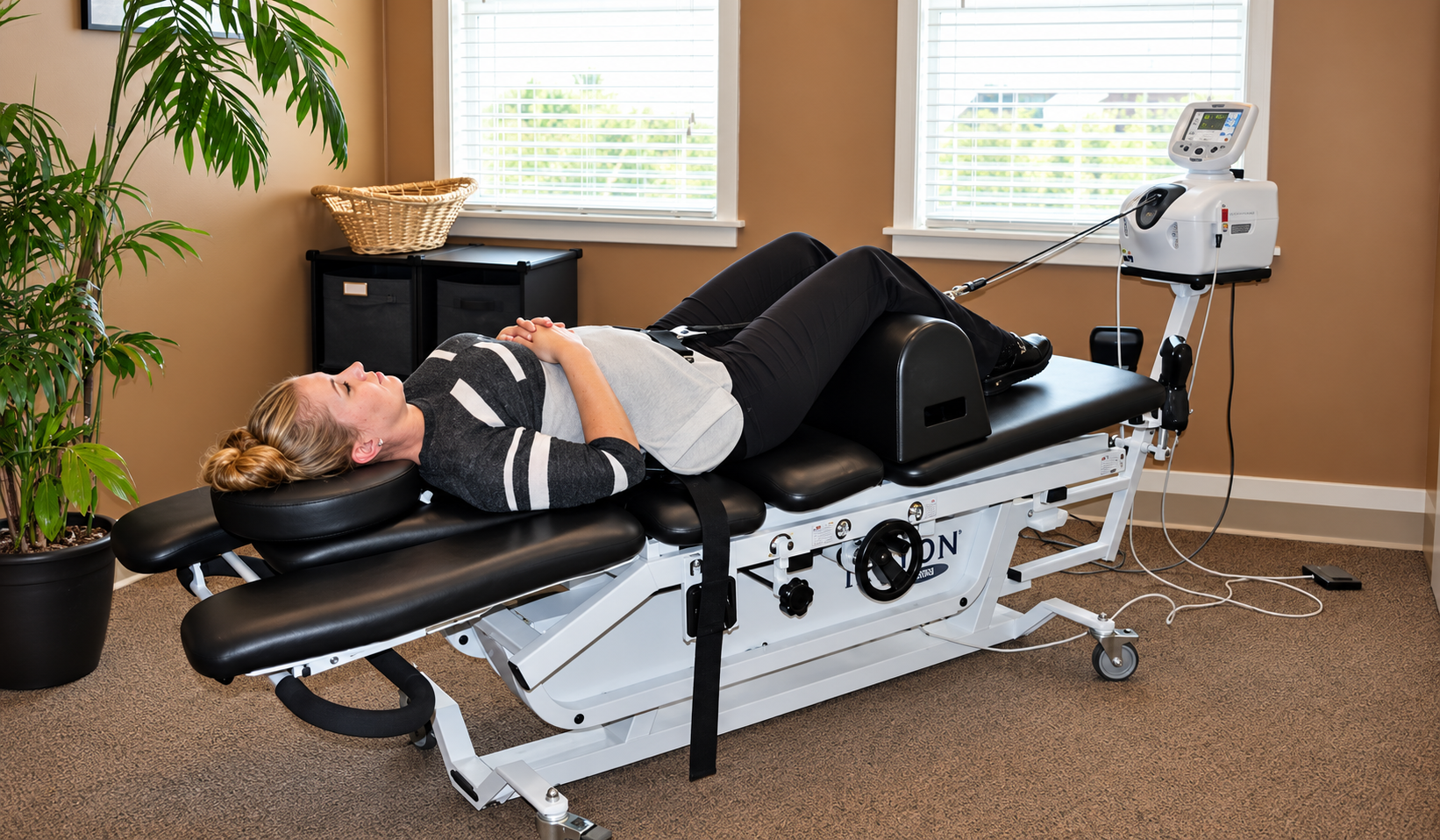
If spinal decompression is considered appropriate, you may be positioned on a specialized treatment table.
The exact procedure depends on the equipment and treatment approach being used. Nonsurgical spinal decompression commonly uses controlled traction or positioning intended to gently influence the spine.
Cleveland Clinic describes traction as a technique that uses a traction table or related equipment to stretch the spine.
Your provider determines the appropriate positioning and treatment settings based on your individual circumstances.
The goal is not to force the spine into a particular position. Instead, the treatment is designed to provide controlled, targeted movement or traction.
What Does Spinal Decompression Feel Like?
Everyone experiences treatment differently.
Some people describe decompression as a gentle stretching or pulling sensation. Others may notice pressure or movement around the treatment area.
Your experience may depend on:
-
The area being treated
-
Your condition
-
Your sensitivity
-
Treatment settings
-
Your position on the table
Communication with your provider is important. If you experience significant discomfort, tell your provider so the treatment can be evaluated or adjusted appropriately.
How Long Does a Visit Take?
The length of your first appointment can vary depending on your individual circumstances.
Your initial visit may take longer than future appointments because it can include a consultation, health-history discussion, physical assessment, and explanation of treatment options.
Future visits may focus more directly on treatment and monitoring your response.
There is no universal treatment schedule that applies to everyone. Your recommended frequency and duration depend on your symptoms, condition, goals, and response to care.
Is Spinal Decompression the Same as Surgery?
No. Nonsurgical spinal decompression does not involve an incision or surgical removal of tissue.
Surgical spinal decompression is a different procedure. It involves an operation designed to remove or alter structures that are putting pressure on nerves or other spinal structures.
Cleveland Clinic distinguishes nonsurgical approaches such as traction from surgical procedures such as diskectomy and laminectomy.
Spinal decompression at Abundant Life Chiropractic refers to a non-surgical approach.
Can Spinal Decompression Help Back Pain?
Spinal decompression may be considered for certain types of back pain, but results can vary from person to person.
Back pain has many possible causes, and not every condition responds to the same treatment.
Mayo Clinic explains that most back pain improves with conservative care and that treatment depends on the underlying cause and severity of symptoms.
This is why an individualized evaluation is important before beginning spinal decompression.
Rather than assuming that every person with back pain needs the same treatment, your provider can consider your symptoms and determine whether decompression may be appropriate.
What About Sciatica?
Sciatica involves symptoms associated with irritation or compression of the sciatic nerve. Symptoms can include pain traveling from the lower back into the buttock and leg, along with tingling, numbness, or weakness.
Some people with sciatica may be candidates for conservative treatment, but the underlying cause matters.
Not every case of sciatica requires the same treatment approach.
If you experience severe weakness, significant numbness, or changes involving bladder or bowel control, seek appropriate medical attention rather than relying solely on conservative treatment.
What Should You Wear?
Comfortable clothing is generally a practical choice for your first visit.
Choose clothing that allows you to move without significant restriction. You may also want to avoid clothing that makes movement difficult.
If you have questions about what to wear or what to bring, you can contact Abundant Life Chiropractic before your appointment.
What Should You Bring?
It can be helpful to bring information about your health history, including:
-
A list of current medications
-
Information about previous injuries
-
Relevant imaging or medical records
-
Information about previous treatments
-
Questions you want to ask
You may not need every document, but providing useful information can help your provider better understand your situation.
If you have previously received imaging or treatment for your back, sharing that information can also provide useful background.
Will You Receive Treatment During Your First Visit?
That depends on your evaluation.
Some patients may be appropriate for treatment during the first visit, while others may require additional evaluation before treatment begins.
The goal is not to automatically provide spinal decompression simply because you requested it. The goal is to determine whether it is an appropriate option for your condition.
Your provider can explain the recommended next steps after reviewing your symptoms and evaluation.
What Happens After Treatment?
After your session, your provider may explain what to expect and what activities may be appropriate.
Some people may experience temporary soreness or stiffness following treatment.
Pay attention to how your body responds. If you experience significant or concerning symptoms, contact your healthcare provider.
Depending on your situation, your overall care plan may also include movement, exercise, lifestyle recommendations, or other supportive approaches.
Movement Still Matters
Spinal decompression should not necessarily replace physical activity.
Mayo Clinic recommends remaining active with many forms of back pain and generally advises against prolonged bed rest. Appropriate light activity can help maintain movement and function.
Depending on your condition, your provider may recommend exercises or activities that are appropriate for you.
Your recovery should focus not only on how you feel during treatment but also on your ability to move and function during everyday life.
Can Lifestyle Habits Affect Back Health?
Your everyday habits can influence how your body feels and functions.
Long periods of sitting, repetitive movements, poor lifting mechanics, lack of physical activity, and other lifestyle factors may contribute to musculoskeletal discomfort.
Depending on your situation, your provider may discuss ways to support your spine outside the clinic.
These may include:
-
Taking movement breaks
-
Maintaining appropriate physical activity
-
Following recommended exercises
-
Practicing good lifting mechanics
-
Getting adequate sleep
-
Maintaining a balanced diet
-
Avoiding activities that aggravate your symptoms
These habits do not replace professional care, but they may complement an appropriate treatment plan.
Is Spinal Decompression Safe?
Nonsurgical spinal decompression is considered a conservative treatment approach, but it is not appropriate for everyone.
Your provider should consider your health history, symptoms, and overall condition before treatment.
Cleveland Clinic explains that treatment decisions should take factors such as your medical history and the severity of your condition into consideration.
If you have experienced significant trauma or have unusual or severe symptoms, additional medical evaluation may be necessary.
When Should You Seek Medical Attention?
Not every back problem should be managed through routine chiropractic care.
Seek prompt medical evaluation if you experience symptoms such as:
-
Severe or rapidly worsening pain
-
Significant weakness
-
Loss of bladder or bowel control
-
Severe numbness
-
Fever with back pain
-
Serious pain following major trauma
These symptoms can require medical assessment rather than routine conservative treatment.
The purpose of an initial evaluation is not simply to determine whether you qualify for spinal decompression. It is also to determine whether the treatment is appropriate for you.
Personalized Care at Abundant Life Chiropractic
At Abundant Life Chiropractic, the first visit provides an opportunity to discuss your concerns, understand your symptoms, and determine what type of care may be appropriate.
The focus is on individualized care rather than automatically applying the same treatment to every patient.
Learn more about us at Abundant Life Chiropractic and explore our full range of chiropractic services.
Available treatment options can be discussed based on your individual needs and evaluation.
Frequently Asked Questions
What is spinal decompression?
Spinal decompression is a term used for non-surgical treatments designed to reduce pressure on spinal structures. Some approaches use controlled traction or positioning.
Is spinal decompression surgery?
No. Nonsurgical spinal decompression does not require an incision or surgical removal of tissue.
What happens during my first visit?
Your first visit may include a discussion of your symptoms and health history, a physical assessment, and an explanation of whether decompression may be appropriate.
Does spinal decompression hurt?
People experience treatment differently. You may feel gentle stretching, pulling, or pressure. Tell your provider if you experience significant discomfort.
How long does treatment take?
Treatment time varies depending on your evaluation and care plan. Your first visit may take longer because it includes an initial assessment.
Can spinal decompression help sciatica?
It may be considered for some people with sciatica, depending on the underlying cause and individual symptoms.
Do I need an MRI?
Not necessarily. Imaging decisions depend on your symptoms, history, and clinical findings. Mayo Clinic notes that imaging is not automatically necessary for every person with back pain.
How many sessions will I need?
There is no universal number. Your treatment schedule depends on your condition and response to care.
Can I exercise while receiving decompression?
Depending on your condition, appropriate movement and exercise may be encouraged. Your provider can recommend activities suitable for you.
Is spinal decompression right for everyone?
No. Certain conditions require different treatment or additional medical evaluation.
Conclusion
Your first spinal decompression visit is designed to help you understand your symptoms and determine whether nonsurgical decompression may be an appropriate option.
The appointment may include a health-history discussion, physical assessment, explanation of treatment, and, when appropriate, an initial decompression session.
Spinal decompression is not a guaranteed solution for every type of back pain. Research and treatment outcomes can vary depending on the underlying condition and the specific approach used.
The National Center for Complementary and Integrative Health (NIH) notes that spinal manipulation may provide small improvements in pain and function for some people with low back pain, while also emphasizing that results can vary.
At Abundant Life Chiropractic in Chanhassen, Minnesota, care is personalized around your individual symptoms, health history, and goals.
If you are experiencing persistent back pain, sciatica, stiffness, or other spinal symptoms and want to find out whether spinal decompression may be appropriate for you, Schedule an appointment with Abundant Life Chiropractic.
Phone: (952) 300-8338
Email: pcc@abundantlifechiropractor.com
Address: 7945 Stone Creek Drive #120 Chanhassen, MN
Website: abundantlifechiropractor.com
The post What to Expect During Your First Spinal Decompression Visit at Abundant Life appeared first on Abundant Life Chiropractic Health Center.
from
https://abundantlifechiropractor.com/first-spinal-decompression-visit-abundant-life/
from
https://abundantlifechiropractic0.blogspot.com/2026/11/what-to-expect-during-your-first-spinal.html
from
https://mildredmiller0.blogspot.com/2026/11/what-to-expect-during-your-first-spinal.html




No comments:
Post a Comment